Written by Josh Veal for REVUE West Michigan

Tucked safely between the peninsulas, Beaver Island is a singular place, untethered from time and unburdened by the mainland’s concerns.

When we traveled there with Jon O’Connor and Kyle Van Strien of Long Road Distillers to scout for juniper berries, it felt like entering another world. It’s a place where the cars are purely functional, running just well enough to move you through the heavily wooded, unpaved roads. A place where you wave, to everyone, always.

But most importantly, it’s a place with rich history and an incredible sense of community, which is crucial to Long Road’s MICHIGIN, a spirit made entirely with Michigan ingredients.

“We joke about getting a place on the island because we feel like we go there so often now,” Van Strien said. “We’re still outsiders coming in, but we definitely feel welcomed by the majority of folks we come in contact with. We always have someone we can call.”

That much was clear from our first trip to the market. Van Strien knew practically everyone there, including the owner, and all of them knew others he could contact. Without the island’s residents, MICHIGIN wouldn’t be possible.

Juniper “berries” are the crux of a good gin, and they only grow in the wild. The small blue orbs are actually cones that lend the spirit its strong pine flavor. Theoretically, if you wanted to simply drive around the countryside and start picking, you could do that, but you’d never know whose property you’re on.

On Beaver Island, however, juniper runs rampant and Long Road’s network of contacts makes it easy to figure out who owns what. We drove around looking for thick patches in the confirmed you-won’t-get-shot areas as Van Strien dropped pins on a robust GPS app. The following week, they would return with staff in tow.

The actual act of picking the berries is a far cry from visiting the orchard with your mom — Long Road’s staff gathered hundreds of pounds over the course of 15 hours, split between two days. The entire process is hard work from beginning to end, which Van Strien fully appreciates. He said it’s much easier to make an all-Michigan whiskey or vodka.

Gin also means sourcing other botanicals locally, such as mint. This year, Long Road also added white pine, foraged from Byron Center Farm, which should dry out the finish a bit and bring the pine flavor up front. The new batch is on shelves now.

All that hard work comes through in the finished products. MICHIGIN has won plenty of awards, including Revue’s own Best of the West readers poll. And in a way, getting to spend any time at all on Beaver Island is a reward of its own.

“It’s so beautiful,” Van Strien said. “It’s one of the coolest places you can visit in the state.”

STORY BY CHAZ PARKS | 269 MagazineThe perfect cocktail is a beautiful thing.

WEST MICHIGAN DISTILLERIES OFFER THE PERFECT THIRST QUENCHERS

It can be a refreshing gin drink on a Michigan summer’s day or a bold bourbon concoction that warms you as winter rolls in. That’s why it may not come as a surprise that craft distilleries across the country grew by nearly 20 percent in 2017, with over 50 of them calling Michigan home. Craft spirits are on the rise, and they are altering the state of cocktails.

“The craft spirits industry has seen tremendous growth over the past couple of years,” says James Loughmiller, Spirits Category Manager at Imperial Beverage. “Michigan alone has been making strides, producing some of the highest quality spirits in the nation. We are usually known as a craft beer state, but recently spirits have started to take hold, and we are seeing a surge of new distillers open throughout the state with a dedication to craft and quality. The craft segment of the spirits category is growing at a rapid pace, and we don’t see it slowing down anytime soon,” Loughmiller confirms.

A shining example of this craft movement comes right from west Michigan. Long Road Distillers has been producing high-end craft spirits since 2015. It is located on Grand Rapids’ west side and has created a stunning home by dedicating their craft to the community that surrounds them. Both co-founders Jon O’Connor and Kyle Van Strien reside on the west side.

“We both have deep roots on the west side of the city, so it was a no-brainer for us to develop this project here. We wanted to give back to the community and make this a shared space with the people that support us. It’s been amazing watching the area thrive over the past three years,” says Van Strien, co-founder of Long Road Distillers.

Southwest Michigan is home to an array of local distillers, from Green Door Distilling in Kalamazoo to Bier Distillery in Comstock Park, and the craft spirits game has exceeded expectations helping to grow the Michigan economy. Operating locally has positively affected the restaurant and retail industry as well as resident farmers who are seeing the boost in their own economic benefits from this new flourishing industry.

Rows of wheat don’t usually come to mind as your bartender makes your Michigan Mule but, when you put quality over everything, it is a must. Utilizing the freshest grain Michigan has to offer, Long Road puts an emphasis on locally sourced agriculture whenever possible. Red winter wheat, for example, is a staple ingredient for the distillery. Long Road utilizes the wheat in several of its products. It is sourced from Heffron Farms in Belding, Michigan, just 25 miles from the distillery.

“It’s in our name. We wanted to make the best locally-sourced product we could with no shortcuts. From our grain to the malt to even the fruit we use for our seasonal limited releases, it all comes from local farms. When we set out to build the distillery, our main objectives were to one, produce world-class, quality spirts that were world-renowned, and two, locally source every ingredient it takes to make those spirits,” Van Strien explains.

Kalamazoo-based Imperial Beverage is fairly new to spirits distribution. Obtaining its ADA (Authorized Distribution Agents) certification in the spring of 2017, its portfolio has grown into a craft-centric powerhouse. Long Road was recently added to that ever-evolving portfolio, making the distiller’s products available statewide for all connoisseurs of locally-sourced spirits in Michigan to enjoy.

“Working with Long Road has been an absolute pleasure,” says Loughmiller. “Its commitment to sourcing ingredients, not spirits, and its dedication to utilize as many local ingredients and farms as possible sets it apart from your everyday distillery. The team there is dedicated, hardworking and goes above and beyond to produce its products. Jon and Kyle have been instrumental in helping our team understand spirits and how to go to market with them. They are truly great partners and friends!”

The results have been worthy of celebration. Long Road has seen early success with the transition to Imperial Beverage, achieving a growth in sales since making the move in spring of this year. The sales team at Imperial works hard to ensure that Long Road products are widely available across the state and is committed to getting their craft into your glass.

Chaz Parks is Donations and Special Events Coordinator at Imperial Beverage, a long-standing member of the Michigan beverage distribution community. Established in 1933 after the repeal of prohibition and purchased by Kalamazoo’s Cekola family in 1984, Imperial has grown from a one county beer distributor to a top 10 statewide beer, wine & spirits wholesaler. With 330 employees and four locations in Kalamazoo, Livonia, Ishpeming, and Traverse City, Imperial provides statewide coverage that serves every Michigan County, every week, all year long.

—–

Long Road Distillers Fall Cocktail Recipe

Make it at home!

2 ounces Long Road Distillers Rye Whisky
0.5 ounces Long Road Distillers Nocino Walnut Liqueur
0.5 ounces Sweet Vermouth
2 dashes Bitters

—–

By Brian McVicar | bmcvicar@mlive.com | October 25, 2018

Northern Michigan residents will soon have a spot to sample the handcrafted vodkas, gins and whiskeys created by Grand Rapids-based Long Road Distillers.

The distillery plans to open a tasting room in Boyne City by the holiday season, said Kyle VanStrien, Long Road’s co-owner.

“It really helps us make a statement to the community that we want to be members,” he said. “We want to be good neighbors, and we want them to think of us when they are thinking of enjoying some Michigan craft spirits.”

The tasting room will be located at 118 Water Street, in Boyne City’s business district. Shoppers can sample Long Road products such as Michigin, created using botanicals from Michigan, including juniper that’s handpicked on Beaver Island.

Long Road’s products can be found at 1,100 stores and restaurants across the state, including at the tip of the Keweenaw Peninsula in Copper Harbor.

But having a tasting room gives the distillery an opportunity to further build its name recognition, VanStrien said, adding that Boyne City is a prime location for doing so because it draws a steady stream of visitors to nearby ski hills, lakes and state parks.

“It’s almost a captive audience for us year-round,” he said. “To be able to tap into that four-seasons market is great.”

The tasting room is geared toward retail sales. There are samples available, but full pours are not permitted.

A local craft spirits maker has won the Best Gin honor at a global blind-tasting competition for gin.

The gin by Grand Rapids-based Long Road Distillers won the top honor and a double-gold medal at the recent Fifty Best gin event, which included 17 pre-qualified judges tasting 41 gins.

Holland-based Coppercraft Distillery also took home a silver medal at the global tasting.

Long Road gin

Long Road’s gin starts with a neutral spirit made at 537 Leonard St. NW from locally grown red winter wheat and features an individually distilled six-ingredient botanical blend.

The product was noted as having notes of lemon, lime, cherry, floral, juniper, eucalyptus and more.

“When we started Long Road Distillers, Jon (O’Connor) and I made a promise to ourselves that we would source our ingredients locally, mill, mash, ferment and distill everything on site at our distillery and filter it honestly,” said  Kyle VanStrien, co-owner, Long Road Distillers. “I believe our commitment to sourcing ingredients, rather than spirits, and using time-honored techniques without taking shortcuts is what sets us apart from others in the industry and in competitions like these.”

Ten gins were awarded double-gold medals, and Long Road’s gin was rated atop other brands, such as Hendricks gin and other staples from the Netherlands and the U.K.

The double-gold medal for gin joins three double-gold medals recently awarded to the distillery’s aquavit. The gin has also previously been awarded gold, silver and bronze medals at various spirit competitions.

Long Road Distillers celebrated its first anniversary last weekend.

“This has been a huge year of progress for Long Road,” said Jon O’Connor, co-owner, Long Road Distillers. “Every award won and distribution expansion made motivates our team to stay committed to our mission and values. We look forward to what the future has in store for our distillery.”

Coppercraft gin

Judges noted smell and taste notes such as lemon, honey dew, toffee, pine, smoky and licorice when evaluating Coppercraft gin.

Coppercraft Distillery includes 13 botanicals in its gin.

Full story here.

A West Michigan distillery has won its second double gold medal and best of show in an international competition.

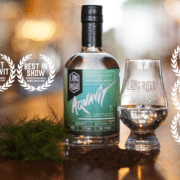
Long Road Distillery won double gold for its Long Road Aquavit at the 16th annual San Francisco World Spirits Competition earlier this month. That honor follows on the heels of the double gold best of show Long Road received for aquavit at the Denver International Spirits Competition in March.

“The San Francisco World Spirits Competition is the most influential in the industry and winning a medal here is very meaningful,” said Anthony Dias Blue, competition director, in a press release. “We have the industry’s most respected experts serving as judges, and every entry is blind-tasted under highly focused conditions. There is no better way to discern quality and identify trends.”

Long Road also won silver for Long Road Gin and bronze for Long Road Wheat Vodka at the San Francisco competition.

The awards were based on the evaluation of 1,899 entries by a 39-person panel of judges. Long Road Aquavit was among 200 spirits to receive the double gold designation.

Aquavit is a traditional Scandinavian spirit. Long Road’s aquavit, and other spirits, can be found at the distillery’s tasting room at 537 W. Leonard St. NW and at more than 100 retailers in Michigan.

“At Long Road Distillers we strive to make spirits worthy of people’s admiration while staying committed to our core value of doing things the right way, from start to finish,” said Kyle Van Strien, co-owner at Long Road Distillers. “This second double gold recognition reaffirms what we set out to do all along and gives us the determination to continue our pursuit of making the best spirits in the world in each category we enter, no matter how big or small.”

Pat Evans, Grand Rapids Business Journal, Full article here: http://www.grbj.com/articles/84973

A local distillery is on par with a $199 bottle of Dewar’s 1846 Signature Scotch Whiskey.

Long Road

Long Road Distillers in Grand Rapids won Double Gold and Best in Show this month at the Denver International Spirits Competition for its Aquavit, the same honors the Dewar’s scotch took home.

“From the beginning, it was our goal to make the best spirits in the world right here in Grand Rapids,” said Kyle Van Strien, co-owner, Long Road Distillers. “For us to tie for Best in Show with Dewar’s . . . is unbelievable.

“We are happy to see so much growth so quickly and are proud to let the quality of our products speak for themselves through these awards.”

The city’s first distillery also won a silver medal in wheat vodka category, a bronze in the flavored/infused vodka category for its Wendy Peppercorn and a bronze in the dry gin category.

In the wheat vodka category, no gold medals were awarded.

“We have always put an emphasis on doing things the right way,” said Jon O’Connor, co-owner, Long Road Distillers. “We have a ‘no-shortcuts’ policy. . . . Earning these awards makes that commitment to quality worthwhile.”

The spirits were judged on a 100-point scale by 20 judges.

There were 200 applicants in the competition.

Other brands in the competition included Bacardi, Johnnie Walker and Jim Beam.

Coppercraft

Holland’s Coppercraft Distillery won a bronze medal at the competition in the straight gin category and a silver in the white rum category.

Coppercraft’s Straight Bourbon and Cask Strength Bourbon both won bronze in the small batch bourbon, 10 years or younger category.


Full story here.

There’s a lot more to Long Road Distillers than just being Grand Rapids’ first distillery.

Kyle Van Strien and Jon O’Connor took an old grocery store on the west side and turned it into a state-of-the-art distillery that, within the first year of operation, is already one of the state’s largest.

As long-term proponents of the city’s west side, Van Strien and O’Connor are expanding on the organic neighborhood revitalization occurring on the corner of Leonard Street and Quarry Avenue with The Mitten Brewing Co. and Two Scotts BBQ.

It helps that the two owners are involved in the community, with Van Strien on the Grand Rapids Planning Commission and O’Connor a newly elected city commissioner – and a Business Journal 40 Under Forty honoree.

The pair are fond of telling their story, highlighting the process of going grain-to-glass with their product, with ingredients sourced from within 30 miles of their Grand Rapids tasting room.

The products are better for it, too. Long Road has already been named Michigan Vodka Distiller of the year, and is helping define what cocktails can be in the Mid-west.

And they know they’re doing in right.

“I’ve tasted it. We know good spirits when we taste them,” Van Strien said. “We went out to find the right equipment you need to make it; we found the guys capable of making it; we’ve put the pieces together to be able to make the best liquid.”

See the full publication for GRBJ’s Newsmakers of the Year here.


GRAND RAPIDS — The West Grand neighborhood in Grand Rapids soon will offer residents and visitors the ultimate trifecta when it comes to craft alcoholic beverages.

That’s because a local cidery plans to open a tasting room in the growing neighborhood along West Leonard Street, a development positioned to complement its neighboring businesses: a microbrewery and a craft distillery.

While having locally-made beer, booze and cider available at consecutive addresses may be a boon for craft beverage fans, those developments and others underway in the immediate area signal a renaissance for one of Grand Rapids’ hardscrabble neighborhoods.

That’s a vibe that Jason Lummen, owner of Grand Rapids-based The People’s Cider Co. LLC, wants to tap into as he plans to open the company’s first off-site tasting room. If his plans are approved by the city next month, he hopes to have cider flowing by May at 539 Leonard St. NW, next door to craft distillery Long Road Distillers LLC and two doors down from The Mitten Brewing Company LLC.

Lummen admits that his plan to move into 450 square feet of space is fairly modest in the broader scope of Grand Rapids development, but it’s indicative of a period of growth not just for his nearly four-year-old business, but also for the West Grand neighborhood as a whole.

“It’s not too much of a stretch and it’s responsible for us,” Lummen said of the tasting room. “It allows us to keep the blue-collar ethic of the cider company intact and allows us to do something to get into what’s going on (on West Leonard). We’re just very fortunate to piggyback with (Long Road) and the guys at The Mitten and to have supportive neighbors.”

The move would give People’s Cider more exposure than it has at its current tasting room and production facility at 600 Maryland Ave. NE near Oak Industrial Park in northeast Grand Rapids, Lummen said. The site would offer seven ciders on tap — including one guest tap — and would be open to guests bringing in outside food.
ADDING DENSITY

If approved by the city, Lummen would rent the West Leonard Street space from Long Road’s owners, Kyle VanStrien and Jon O’Connor, who were also drawn to the opportunities presented by the neighborhood revitalization. Indeed, VanStrien and O’Connor plan to “double-down” on that revitalization with a proposed new mixed-use development of their own.

They’re in the early planning stages of converting an abandoned and contaminated gas station property at 555 Leonard St. NW into a two-story or three-story project with potential apartments or offices upstairs and a ground-floor commercial tenant that’s “complementary” to neighboring businesses.

Currently, the Kent County Land Bank Authority is using state funds to clean up the contamination at the 96-foot by 132-foot site. Following the remediation process, an entity controlled by the owners of Long Road plan to acquire the property.

VanStrien said he wants to attract some mixed-use development to the area along the West Leonard corridor similar to what’s developed in neighborhoods like East Hills and along Bridge Street in recent years.

“We need more density and to build up the population so that they can support the businesses,” VanStrien said.

O’Connor agreed.

“We believe in developing in a good urban context,” he said. “We see opportunity in this neighborhood and we are putting our money where our mouth is.”

The West Grand Neighborhood Association welcomes the prospect of adding new housing and other businesses to the area.

Interim Executive Director Annette Vandenberg told MiBiz the neighborhood strives to support developers, provided they attempt to accommodate all income levels and make a push to hire people already living in the West Grand area.

“Anyone who’s willing to create jobs and housing for all income levels, we think that’s a great idea,” said Vandenberg, adding that the neighborhood association board is in the process of drafting a letter of support for the proposed People’s Cider tasting room.

She added that the board is aware of the proposed gas station redevelopment, but the parties have not yet had formal talks.

“Nothing functions here without the support of the community,” Lummen said. “That’s the big thing. I love the vibe and it’s the residents that will continue to support these things. People are walking from their houses to come to these establishments, and it’s more and more people everyday.”
TAKING NOTICE

While plans for the gas station site remain in the early stages, VanStrien and O’Connor said they hear increasing demand for newly built quality housing options in the neighborhood.

As proof, they noted that many staff members at Long Road now live in the immediate area.

Other investors appear to be taking note of the demand as well. A drive or walk down the West Leonard corridor shows multiple older buildings — many of them vacant — quietly being worked on and at various stages of construction and redevelopment.

Additionally, the property at the southwest corner of Leonard Street and Broadway Avenue went up for sale in early January for $1.5 million, according to the property listing. The site consists of two single-family homes and four commercial buildings with frontage on Leonard Street. It last sold in 1999 for $60,968, according to property records.

Long Road’s owners say they’re hopeful more developers come into the West Grand neighborhood and activate many of the vacant buildings in the area. And while they’re confident that their proposed mixed-use project will take place, VanStrien and O’Connor said it was too early to offer a specific timeframe for the redevelopment because the growth and sustainability of their distillery operations must take priority.

Since launching in late May last year, Long Road has focused on ramping up its distribution efforts and already expanded with an upstairs event space and music venue. In the coming months, the distillery also plans to release a variety of small-batch aged ryes and whiskeys.

As they continue to develop the plans for the mixed-use project, they’re watching the neighborhood grow and eyeing needs that could be filled in the ground-floor commercial space at the redevelopment.

“The first two things that came to our head were cider and coffee,” O’Connor said of needs in the neighborhood. “We saw this as a really great opportunity to do something unique in the fact that I can’t think of another place in this country where you can get beer, liquor and cider in consecutive addresses and independently owned and operated. … The fact that we have three independent things is just a unique opportunity to sort of put a foothold here as this corner of craft beverage making.”

Full Story by Nick Manes available here.

With craft distilling on the rise, some are cashing in without even making their own product.

By Pat Evans and Jesse O’Brien for the Grand Rapids Business Journal

The story behind a bottle of spirits sitting on the shelf might be murkier than its contents.

Look closely at that bottle and the label can be confusing — and misleading.

There are a variety of descriptions that can be slapped on a label, including, “Distilled in,” “Bottled In,” “Manufactured In,” “Produced In,” “Aged In” and any combination of those.

Just because a label reads “Bottled in Michigan” does not mean the spirits were made in Michigan, said Kent Rabish, owner of Grand Traverse Distillery in Traverse City. If it reads anything other than “distilled,” at least in whiskey, it wasn’t made by the company.

Rabish said the distilling industry is mostly split in two camps, with producers and merchant producers.

Producers, like Grand Traverse Distillery and Long Road Distillers, are involved with nearly the entire process of distilling, from grain to bottle. Merchant producers purchase their spirits from a larger distillery, often in bulk quantities and sell it under their own label.

This shouldn’t be a problem, Rabish said, unless the “craft” distiller is intentionally deceiving the consumer. In some cases, he said, distillers are buying their spirits from industrial factories that churn out whiskey, and then sell it under a “craft” label.

“I think that’s kind of the tragedy of non-distillers,” Rabish said. “They’re clogging the shelves. It looks like craft, like they bring raw grain in, like they have product they’re making. (Craft) costs more, but it’s a better product.

“I try to point out to people, why do most vodkas taste alike? Because most are made by the same handful of companies.”

Rabish anticipates that soon enough, consumers will begin to notice the difference in taste, and the divide between distillers and merchant producers will become clearer.

“It’s getting out there and I do think the customers of craft spirits will start hearing rumblings and start hearing more and more about who’s making it and who are the merchant distillers,” Rabish said. “There’s no reason you can’t set up a company and be a merchant distiller, you’ve just got to be straightforward with what you’re doing.

“And I think over time it’s going to pan out. I think long term, the ones who are going to succeed in this industry are the ones who are honest about their product.”

There is some gray area as producers are often limited by the type of still they have and might only be able to produce a whiskey or vodka or gin, and would like to package and sell the others, said Jon O’Connor, co-owner of Long Road.

“There are layers. There are legit distillers making all their own whiskies but they buy vodka,” O’Connor said. “At least they’re trying to make some stuff — that’s good.”

Still, many distilleries opening up across the country perform zero distillations because the rebranding of already distilled spirits makes financial sense as starting a distillery is a capital-intensive business.

A distiller hoping to enter the market and create an authentic product with an authentic brand would first need to spend approximately $1 million on necessary equipment, thousands of pounds of grain, labor and utility costs to run a still three times, mash for eight hours and hand bottle and label the finished product. Distillers hoping to sell authentic aged whiskey must sit on inventory for years before it’s ready to sell.

“We’re not playing the short game; it’s capital intensive,” O’Connor said. “That’s why people take the short cut. To get whiskey takes a while. To make vodka is not cheap.”

Rabish said some new distillers might choose to buy their whiskey from an industrial manufacturer, with the intention of selling their own whiskey after it’s been aged. In theory, a distiller could build its brand this way, selling bottled whiskey until it is ready to bring its own aged whiskey to the market. However, that’s not always the case.

“There’s a number of brands out there that have been on the market for four or five years and still not selling their own whiskey,” Rabish said. “They’re selling product, they’re making a profit, but I think five years from now, customers will figure it out and it’ll catch up to them.”

That’s where “clogging the shelves” comes into play. Nondistillers are selling bulk-produced spirits under the guise of being handcrafted at a significant advantage, due to the large disparity in manufacturing costs.

A $14 bottle of “craft” vodka on a liquor store shelf is relatively impossible, O’Connor said.

“You can’t do it without buying vodka for $1.50 a gallon,” he said.

Antiquated state liquor laws have a big effect on the end shelf price, said Kyle Van Strien, O’Connor’s partner at Long Road.

At the federal level, producers are taxed by gallons produced. So small distilleries like Long Road and larger ones such as Smirnoff are taxed at the same rate based on how much they produce. Michigan, however, taxes based on how much a distiller can sell its product to the state, creating a huge disadvantage for smaller producers.

“For us, a bottle of vodka, maybe we’re paying more than $8 in state taxes,” Van Strien said. “Popov pays about $2.50 for the same quantity of vodka because it’s cheap and they produce on such a (large) scale that they can.”

The mass-produced quantity is where it becomes an issue as some “craft” distillers can buy from those massive producers and bottle it and label it as their own and sell it for a “craft” markup of $30 or more a bottle.

“It costs eight to 10 times more to start with grain,” O’Connor said. “You can buy a gallon of high proof vodka for two bucks a gallon, and the margins are exceptional if you can throw a craft brand on it and sell it for $30 bucks.”

Several major brands have been caught in the transparency issue, including Tito’s Handmade Vodka and Templeton Rye Whiskey.

In 2014, following an article in Forbes magazine detailing the process of Tito’s handmade process, several lawyers sued Tito’s over that key word in the name: “handmade.” While Tito’s has an elaborate story, the reality is the vodka starts as a neutral grain spirit shipped from a factory in Iowa and redistilled as Tito’s vodka.

Judges in various courts have been torn in the decision on Tito’s, including in New York and California where judges ruled consumers can be confused by the term, while in Florida the judge dismissed five of six charges.

Templeton settled three class action lawsuits last year in cases questioning the whiskey’s “Made in Iowa” claim, as the whiskey is really made by a company in Lawrenceburg, Indiana. Templeton also had produced a branding story suggesting it was using a pre-Prohibition recipe for “small batch rye whiskey.”

Both Tito’s and Templeton have turned into national brands, with similar stories happening at a more local level, and it doesn’t help the distillers trying to build an authentic brand from scratch, Van Strien said.

“It’s not bad whiskey or vodka,” O’Connor added. “Everyone picks the way they do business. For us, the authenticity thing has been so paramount to what we want to do. Do you want to lie to people to make a fast buck? (If) that’s your business model, go ahead.

“But I don’t want to be compared to someone else because I’ve chosen to do something in an authentic manner.”

Full story available here.

The West Leonard beverage scene is growing bigger.

Hard cider maker People’s Cider Co. is planning to open a tasting room in Grand Rapids, at 539 Leonard St. NW, next door to craft spirits maker Long Road Distillers, at 537 Leonard St. NW, and at the same corner as Mitten Brewing Co., at 527 Leonard St. NW, and Two Scotts BBQ.

The plans still need go to the Grand Rapids Planning Commission on Feb. 11, as well as the city commission and liquor control commission.

“There is no other place, that we know of, that these places exist with a consecutive address,” People’s Cider owner Jason Lummen said of having a brewery, distillery and cidery all in a row. “It’s not one large project. It’s three separate businesses all collaborating with each other.

“We’re all creating things that are enhancing the neighborhood, continuing to make it a great place to live and a great place to work.”

Lummen hopes the space will be completed and open by May 1, the fourth anniversary of the company.

The space

The opportunity came when the same company that owns the Long Road Distillers building, which owns the site next door, separated the Chicago Style Gyro shop, which will remain open.

“What we’re effectively doing is utilizing the urban street wall,” Lummen said.

The owner of the buildings didn’t want to lose the gyro shop, however.

“They’re a great asset to the neighborhood and add a diversity of food we don’t have in many places in this city, let alone this neighborhood,” Long Road Distillers co-owner Kyle Van Strien said.

People’s Cider

People’s Cider is currently operating a tasting room out of its 1,000-square-foot production facility in Grand Rapids, at 600 Maryland Ave. NE.

The new tasting room will open up about 400 square feet of space that People’s Cider can use for expanded production. Last year, People’s produced about 5,000 gallons of cider, and Lummen expects this move to double the number.

“Right now, I’m limited by how much finished product I can put out in a week, and this will drastically increase production capabilities,” Lummen said. “I want to be good to the existing wholesale we have now and use the space to grow the brand.”

The new tasting room will also be the first time Lummen has needed employees.

“It’s still pretty small, but it’s big for us,” Lummen said. “It’s more than I can handle. But I’m happy to be able to provide income for more people and families.”

Former plan

In 2013, Lummen had plans to open a tasting room on Jefferson Avenue. The plan, however, fell a part when a new owner purchased the building.

Lummen said that was a blessing in disguise.

“I wish it could have worked out, but it’s funny how things always work out,” Lummen said. “That one was a little bit early, but this one I’m ready for. I was extended a little bit further than I should have then, but it didn’t sink the project.”

This opportunity comes at a time when he feels it’s better for the company and as production needs to be increased.

It’s also in a neighborhood he would pick over any other in the city, despite being a lifelong Eastown devotee.

“If I sit down and think about where I want to be, this is where it’d be,” Lummen said. “This is a premier neighborhood of Grand Rapids and is extremely proud and vibrant.

“It’s a great place to live, great place to work, and I hope to add to the diversity.”

Full Story Here.

Book A Tour